Creating Silvopasture

As the saying goes, “grass grows grass”. But what if you don’t have grass to start with? I want to share some observations that I have made turning forest into silvopasture using my flock of Icelandic sheep. I am going into my third season with my flock, fourth season for creating silvopasture. This last year has been eye-opening; I am beginning to understand the factors which enable grass growth. Whether you’re looking to graze marginal forested land on your property or are in search for late season forage, this article will explain how to create pastures in the woods.
In the Woods
I live on 80 forested acres in the heart of the Upper Peninsula of Michigan. The Upper Peninsula (or U.P.) has been clear cut 2-3 times in modern history, most infamously to rebuild after the 1871 Great Midwest Fires which burnt Chicago, Peshtigo and other cities across Illinois, Wisconsin and Michigan to the ground during a drought. Two and a half million acres of forest in lower Michigan alone was destroyed in the fire.

Our land is densely planted with mostly hardwoods – sugar maple, cherry, and hickory – with logging in mind. Densely planted trees grow straight without many branches due to competition with the other trees. While this is ideal for milling, you lose diversity of plant and animal habitats.
Pruning the Forest
I have come to think of the art of creating silvopasture as the macro version of pruning a fruit tree: remove dense or overlapping branches (or trees); prioritize the strongest, most abundant branches (or trees); focus on improving sunlight and airflow (to the forest floor). When done thoughtfully, you create a park-like ecosystem with large trees and plenty of grasses and forbes in between. The trees provide shelter and shade to your sheep, as well as a late season food source. More about that later.
Joel Salatin has quite a few resources on creating silvopastures. He stresses the high risk associated with planting grass seed: the seed won’t take, untimely rain, or a massive flock of migratory birds comes in and eats all the seeds in the spring (ask me how I know). I have tried to follow this philosophy, but the Upper Peninsula has been forested for its entire history. Most of the grasses growing natively in the our woods are poor forages (sedges, deer grass, etc.). While we do have a modest soil seed bank, I was not seeing the quick results I had hoped for except in areas where I fed hay in the winter.

During winter, I station my flock in my newest silvopasture paddock. I feed small square bales on the ground, trying to place hay in a new location every day. We get an average of 140 inches of snow annually, so the ground stays clean all winter. Inevitably when the snow gets deep, I feed along established pathways and near the gates more frequently. In the spring it is abundantly clear where I bale grazed in the winter versus where I did not. I have not quite figured out whether this is due to the seeding from the hay, the increased nutrients from the sheep, the disruption of the soil, or a combination of all. I suspect it is the combination, but I have noticed that grass will not grow in areas that are still covered by leaf litter. The disruption and/or change to soil composition that you get with mulching with hay seems to be necessary when getting grass to grow. An interesting anecdote about disruption: one fall when putting in fence, we got our skidsteer stuck in the mud. We made some ugly ruts in a far back corner of the forest where I did not yet keep sheep or feed hay. The next spring grass sprouted up in those ruts, but nowhere else. This leads me to believe that some disturbance (or destruction of leaf litter) is required for grass growth.
In the spring, there are areas where I fed hay more heavily which do not sprout grass due to the deep litter. This is only temporary. By the end of the summer, these areas became some of my most productive. As you continue your management of this land, your soil microbiome will adapt and begin to break down hay more quickly.

Shoulder Seasons
The most productive time of year to create silvopasture is during the dearth going into winter. In late September or early October, I set up a large amount of electronet in an area I hope to convert into silvopasture and park the sheep here for the remainder of the season. Each day, I cut down a few trees for the sheep to feast on. I also supplement with hay, feeding as described above. You can find forage analysis online for different types of leaves. In general, tree leaves are high protein and the sheep do well on them. That being said, they much prefer the combination of leaves and hay. The fiber in the hay allows the sheep to process the additional protein without upsetting their stomachs.
When the sheep finish the leaves on the downed trees, we will usually chip the remainder of the tree to mulch our pathways. Sometimes we create burn piles to light in the winter time when we don’t risk a forest fire. The sheep will dig up these burn piles all winter through the snow to eat the biochar.

Additional Bits & Bobs
Here are a few additional rapid-fire thoughts about silvopasture.
Diversity of Nutrition
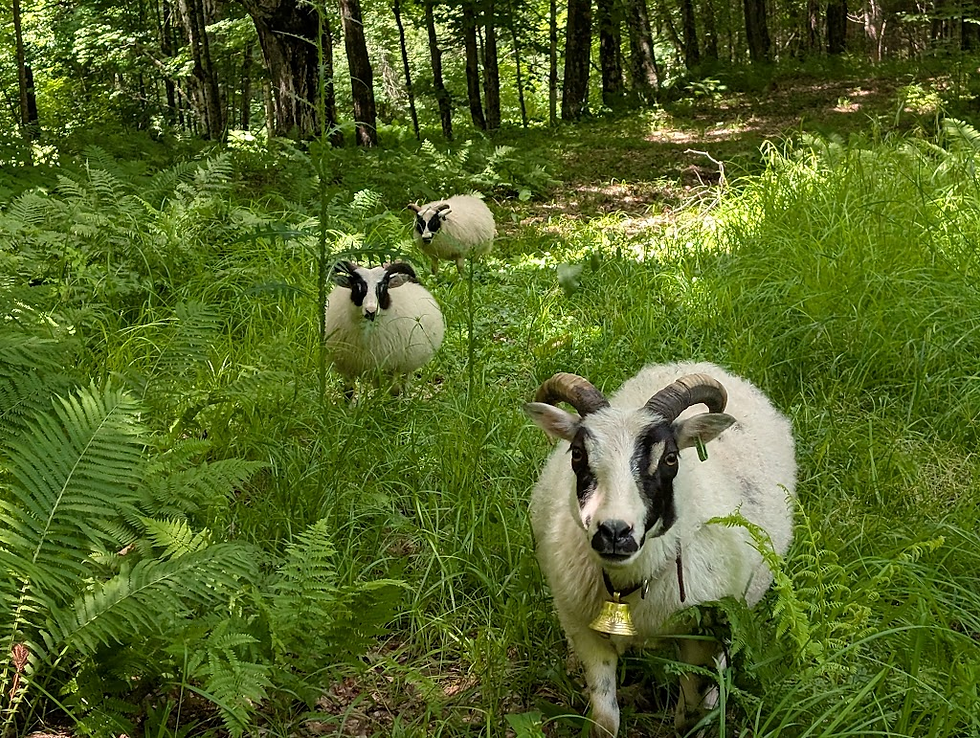
Despite raising my sheep in an unconventional setting, they do remarkably well foraging in the woods. In the summer time, I rotate them through the forest, along established grassy pathways to clear out saplings and underbrush along our pathways. I return the flock to our fenced silvopastures at night where we have intentionally thinned the trees. I supplement with hay at night both for a more balanced nutritional profile for the sheep and to mulch the paddock.
The flock appreciates the shade and shelter provided by the trees. They especially like to nibble the pines and hemlocks in the winter. As far as I can tell, evergreens are the primary food source of our native whitetail population and the sheep quickly learn to follow suit. My sheep will strip the outer bark off of younger trees, especially maples in the winter. I don’t mind this so much because every year I thin the smaller and weaker trees from each paddock to increase the sunlight. However, if you have some younger trees that you want to save, be sure to fence them in before overwintering your flock with the saplings.
Do note that some trees, most notably the black cherry, can be poisonous to all livestock when the tree is stressed. When ingested, prussic acid from cherry transforms into cyanide in the rumen. This typically happens if the sheep eat leaves off a fallen branch after a wind storm. I do clear cherries from my permanent paddocks to avoid this situation, but I am not removing them from the entire property. I have seen the sheep eat healthy cherry saplings and leaves with no ill-effect, but it is a risk that you run. Be sure to research your native flora and adjust accordingly.
Stumps
We tried digging out a few of the stumps and created really ugly holes and a pile of large stumps that don’t burn well. So now, we leave the stumps in the ground. Over time they decay and the sheep love to eat the decayed wood, especially in the wintertime.
Keep the flock small, but not too small
I started my first year with three ewes. While it was a great introduction, I didn’t see much progress in grass growth until my second year, when I overwintered 7. The summer I had a total of 16, which was pushing the limits of my relatively sparse forage. We were grazing in the back corners of the our 80 acres along the pathways. Each year, more grass grows, but don’t expand too quickly if you don’t have a larger pasture to fall back on.
Rest
Multiple paddocks means you can rest others. Usually, the first year establishing silvopasture, I will “overgraze” the paddock. I park the sheep in the same location at night, every night and feed hay. The sheep clear the small saplings and forbes. The next spring, I will keep the sheep off this area, both to control parasites, but also to let the tender grass shoots grow and establish themselves. Once the grass growth is 6-8” I will graze the area quickly, rest and repeat to establish strong root systems.
Final Thoughts
Establishing silvopasture is labor-intensive and a moderately slow process, the resulting landscapes are beautiful, productive and nutritious for your flock. Years ago, the native people managed forests in a similar way: thinning the forests of young and sickly trees to use for firewood, leaving only the largest and healthiest behind. This management style helped prevent the destructive forest fires we see today due to lack of active management of our forest resources. Think of creating silvopasture as pruning your forest. A bit of active management of marginal forest land can turn it into a productive ecosystem for both your livestock and local wildlife.
Comments